12 Fabric Stain Samples: Results with Six Specialized Stain Removers
These 12 fabric samples were not treated as one generic Spot Lifter job. The supplied record matched them to six specialized stain removers, JJW-901 through JJW-906, and documented an outcome for each numbered sample.
In this set, Samples 1–9 were recorded as clean after treatment. Samples 10 and 11 showed fabric color loss while the print or dye mark remained. Sample 12 still showed visible ink residue. Those observations apply to this sample package only. They are not a universal removal rate, a fabric-compatibility guarantee or a record of customer acceptance.
What the source package contains
The source package includes a workbook, before-and-after photographs, eight treatment videos and a photograph of the six labeled sample bottles. The filenames and worksheets span 6–8 July 2026; they do not establish one common treatment date for all 12 samples.
The bottle labels identify the products used for this review:
| Model | Name shown in the supplied material |
|---|---|
| JJW-901 | Food Stain Remover |
| JJW-902 | Beverage Stain Remover |
| JJW-903 | Oil Stain Remover |
| JJW-904 | Ink Remover |
| JJW-905 | Rust Remover |
| JJW-906 | Dye Remover |
These names establish the product identities used in this case. They do not replace the current label, TDS, SDS or workplace procedure for any model.
Sample-by-sample results
The table preserves the stain labels in the supplied record. Where more than one model appears, the worksheet associates several removers with that sample but does not state their order, quantity or individual contribution.
On smaller screens, scroll horizontally to read all three columns.
| Sample | Recorded stain and remover(s) | Recorded outcome |
|---|---|---|
| 1 | Food stains; JJW-902, JJW-901 and JJW-906 | Recorded as clean after treatment |
| 2 | soil mark; JJW-903 | Recorded as clean after treatment |
| 3 | Textile Marker; JJW-904 | Recorded as clean after treatment |
| 4 | Pen Mark; JJW-904 and JJW-903 | Recorded as clean after treatment |
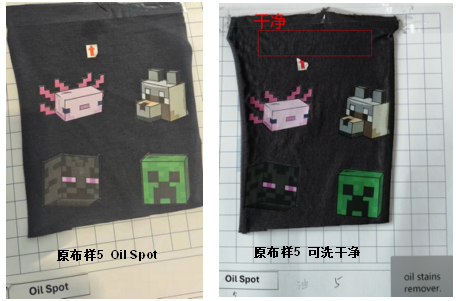
| 5 | Oil Spot; JJW-903 | Recorded as clean after treatment |
| 6 | offset printing; JJW-904 and JJW-903 | Recorded as clean after treatment |
| 7 | Dirty Spot; JJW-903 | Recorded as clean after treatment |
| 8 | Rust spot; JJW-905 | Recorded as clean after treatment |
| 9 | Chemical Spot; JJW-903 and JJW-906 | Recorded as clean after treatment |
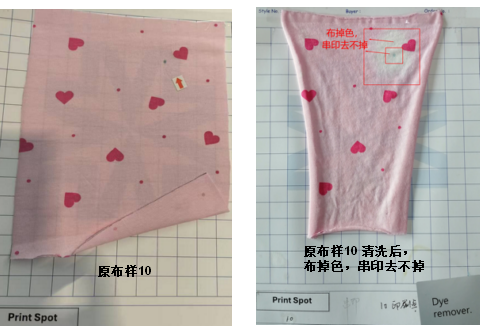
| 10 | Print Spot; JJW-906 | Not fully removed; the after-treatment photograph records fabric color loss and transfer print remaining |
| 11 | Dyeing Spot; JJW-906 | Not fully removed; the after-treatment photograph records fabric color loss and the dye stain remaining |
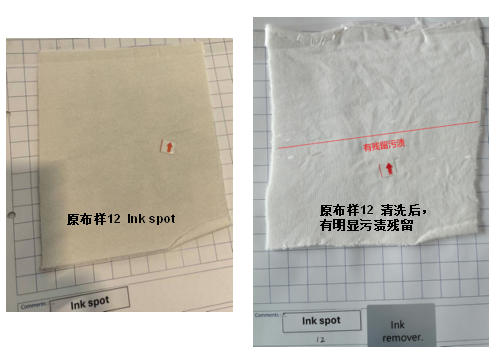
| 12 | Ink spot; JJW-904 | Not fully removed; visible stain residue remained after treatment |
“Chemical Spot” is the wording in the source record, not a laboratory identification of the stain. The same caution applies to broad descriptions such as “soil mark” and “Dirty Spot.”
What the three incomplete results show
Samples 10 and 11 matter because the remaining mark was not the only issue. The after-treatment photographs also show color loss. A stronger or repeated treatment cannot be assumed to produce an acceptable fabric once the material itself has changed.
Sample 12 shows a different limit: visible ink residue remained after treatment. A partial visual change should not be recorded as complete removal.
For a production decision, stain reduction and material acceptability need separate observations. A useful record states whether the mark changed, whether the fabric color, print, hand or finish changed, and whether the result met the buyer’s acceptance standard.
What this case establishes
- Six specialized removers, JJW-901 through JJW-906, were identified in the sample package.
- The record associates each of the 12 numbered samples with one or more of those removers.
- Samples 1–9 were marked clean in the supplied before-and-after record.
- Samples 10–12 were recorded as not fully removed.
- The unsuccessful group includes two color-loss observations and one sample with visible residue.
It does not establish that nine out of every 12 stains will be removed, that the same product will behave the same way on another fabric, or that the buyer accepted the nine samples. It also does not provide enough information to publish a universal sequence, dosage, dwell time or operating procedure.
Preparing a fabric-stain sample enquiry
A supplier can assess a sample set more accurately when the enquiry keeps the stain, fabric and acceptance criteria together. For each sample, provide:
- a unique sample number and a clear before-treatment photograph;
- the stain source, if known, or an explicit “unknown” if it is not;
- the fabric construction, color, print or dye, finish and care requirements;
- any treatment already attempted and the observed reaction;
- the result that would count as acceptable, including limits on color change, print damage or residue;
- the destination market, required documents and expected order quantity when the review is connected to sourcing.
Do not choose a model from the stain name alone. A stain label is a starting point; the material, previous treatment and acceptance standard can change the decision.
Request a Quote with the numbered sample information and available photographs. For a general question about the review process, Contact Us.
Source note: This article is based on a customer-supplied workbook and photo/video package dated 6–8 July 2026. Model names and selected media are published with permission. Client-identifying details are omitted. The observations describe this sample set; no independent laboratory validation or customer acceptance is claimed.